The Psychology of “Just in Case”: Why It’s So Hard to Declutter
There are three words I hear almost every time I help someone declutter:
“Just in case.”
Just in case I need it.
Just in case it comes back in style.
Just in case I lose weight.
Just in case money gets tight.
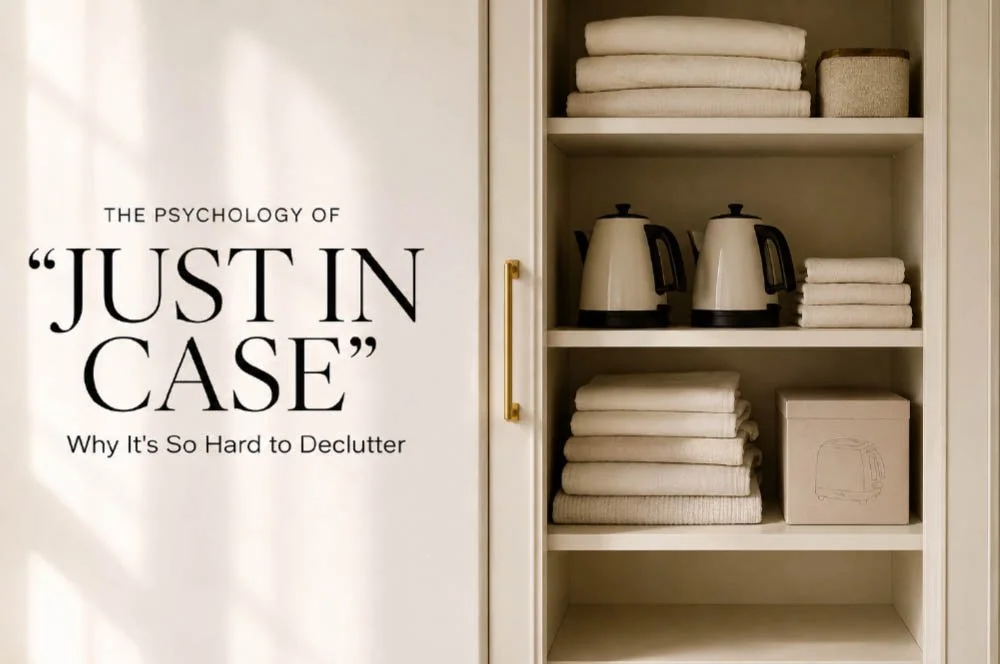
Just in case the toaster breaks, we suddenly need eight sets of sheets, or that mystery cord turns out to be extremely important.
Sound familiar?
“Just in case” is one of the biggest reasons we hold onto clutter. And honestly, it often has very little to do with the item itself.
The Stories We Tell Ourselves
When we’re deciding whether to let something go, our brains can come up with some very convincing reasons to keep it:
But what if I need it someday?
It still works.
I paid good money for it.
What if I regret donating it?
I never argue with my clients when I hear these things because I understand where those thoughts come from.
For many women, “just in case” isn’t really about the extra blender, the old set of sheets, or the sweater that hasn’t been worn since 2017.
It’s about feeling safe.
Keeping the item creates a sense of preparedness. It tells us that if something goes wrong, if our circumstances change, or if we suddenly need that exact thing, we’ll be ready.
Even when the item has been sitting untouched for years, letting it go can feel like giving up a small piece of security.
When Keeping Things Helped You Feel Safe
Maybe you grew up in a home where money was tight.
Maybe your parents or grandparents saved everything because they had to. Throwing away something usable wasn’t an option. Everything was repaired, reused, repurposed, or saved for another day.
Maybe you’ve lived through a divorce, a layoff, an illness, or a season when every dollar mattered.
Or maybe you’re like me.
When my family immigrated to the United States, we didn’t have much. When you’ve experienced having very little, it changes the way you look at things.
You don’t automatically see an old toaster.
You see, “What if someday I can’t afford another one?”
Those experiences stay with us—even when our circumstances change.
Our homes may be different. Our income may be different. We may have access to things we didn’t have before. But part of our brain is still trying to protect us from the possibility of not having enough.
If you struggle to let go, I want you to know something:
You’re not crazy.
You’re not lazy.
And you’re not bad at decluttering.
Your brain learned that keeping things meant staying safe. At one point, that may have been a very smart survival strategy.
The problem is that sometimes we never update the strategy.
“But It’s Still Good”
One of the hardest categories to declutter is the perfectly usable item that we simply don’t use.
It isn’t broken. It isn’t expired. There is technically nothing wrong with it.
So we keep it.
But an item doesn’t have to be broken to no longer belong in your home.
A shirt can still be in good condition and not fit your body or your life.
A kitchen appliance can still work and never be used.
A decorative item can be perfectly lovely and not be something you want to look at every day.
A set of sheets can still be usable even though nobody in your home likes sleeping on them.
The question isn’t only, “Is this still good?”
The better question is, “Is this still good for me?”
If it isn’t, letting someone else use it may be a better way to honor its value than storing it indefinitely.
The Hidden Cost of Keeping Things
Here is something I often ask my clients:
What is this “just in case” item costing you today?
Because clutter has a cost too.
Maybe you’re keeping six sets of mismatched food containers just in case.
Meanwhile, every time you open the cabinet, something attacks you.
I swear Tupperware has meetings after we go to bed. They’re plotting.
“Tomorrow, ladies—we jump.”
Maybe you have three different sizes of clothing hanging in your closet just in case your body changes. Now every morning begins with pushing past clothes that don’t fit and wondering why getting dressed feels so frustrating.
Maybe you’re storing an extra piece of furniture because someone may need it someday. In the meantime, you’re walking around it, cleaning around it, and using it as another place to put things.
The cost of clutter isn’t only measured in square footage.
It costs you:
Time spent searching for what you need
Energy spent moving and reorganizing things
Frustration when cabinets and drawers don’t function
Visual noise that makes your home feel unsettled
Money spent buying duplicates because you can’t find what you own
Mental energy spent thinking about unfinished decisions
You are cleaning around these things, moving them, organizing them, looking at them, and thinking about them.
Every. Single. Day.
Eventually, the cost of keeping something can become greater than the possibility that you may need it someday.
Ask a Better Question
Instead of asking:
“What if I need this someday?”
Try asking:
“What is this costing me right now?”
I love this question because it brings you back to the life you’re actually living.
“What if” focuses on a future that may never happen. “What is” asks you to look at your home, your routines, and your needs today.
Is this item helping you?
Is it earning the space it takes up?
Or is it quietly making your life harder?
You might also ask:
When did I last use this?
If I needed it again, could I borrow or replace it?
Would I even remember that I own it?
Am I keeping the item—or the fear attached to it?
Could someone else benefit from it now?
This doesn’t mean you have to get rid of every backup item in your home. Keeping an extra roll of paper towels is practical. Keeping four broken lamps because you might learn electrical repair someday is something else.
The goal isn’t to become unprepared.
It’s to recognize the difference between being prepared and being controlled by fear.
Letting Go Requires Self-Trust
Here is what I’ve learned after helping hundreds of women declutter:
Confidence doesn’t come from keeping everything.
Confidence comes from trusting yourself.
Trusting that if life changes, you will respond.
Trusting that if you make an imperfect decision, you will survive it.
Trusting that you do not need to predict every possible future in order to feel safe today.
Because let’s be honest: you have already figured out things much harder than replacing a kitchen gadget.
You have adjusted to changes you never expected. You have solved problems without having all the answers. You have found a way forward during difficult seasons.
That ability lives in you—not in the things stored in your closets.
How Spot & Toss™ Helps Build That Trust
This is exactly why I love Spot & Toss™.
I’m not asking you to empty your entire garage or make 100 emotional decisions in one afternoon.
I’m asking you to practice.
One item.
One decision.
One small moment of trusting yourself.
Every time you let go of something you no longer need, you’re giving your brain a new message:
I am safe.
I will be okay.
I don’t have to keep everything to be prepared.
Those little decisions add up.
Eventually, the voice asking, “But what if?” becomes quieter—and your confidence becomes louder.
Try This With One Item
This week, find one thing you’ve been keeping “just in case.”
Just one.
Please don’t begin with the most sentimental or emotionally complicated item in your home. Start with something that makes you think:
“Honestly, I haven’t touched this in years.”
Hold the item and ask yourself:
What is this costing me today?
Is it taking up useful space?
Does seeing it make you feel guilty?
Do you keep moving it from place to place?
Is it making a drawer, cabinet, or closet harder to use?
If the item is costing you more than it is giving you, maybe it’s time to let it go.
Not because you can guarantee you’ll never need it.
Because you trust yourself enough to know that if the future changes, you’ll handle it then.
Sometimes the hardest thing to release isn’t the item.
It’s the story we’ve attached to it.
Be gentle with yourself. You’ve lived through hard things. The instinct to protect yourself didn’t come from nowhere.
But you can appreciate how that instinct helped you in the past without allowing it to run your home today.
Give yourself permission to trust that you’ll get through future challenges too.
One small decision at a time.
With Love,
Margo
Practice Letting Go With Support
If “just in case” thinking keeps you stuck, join the 7-Day Spot & Toss™ Decluttering Challenge.
Each day, I’ll guide you through one small decluttering task with a quick audio message and realistic encouragement. We’re not trying to become minimalists overnight. We’re practicing making one good decision at a time.