You Don’t Need More Storage—You Need Fewer Things
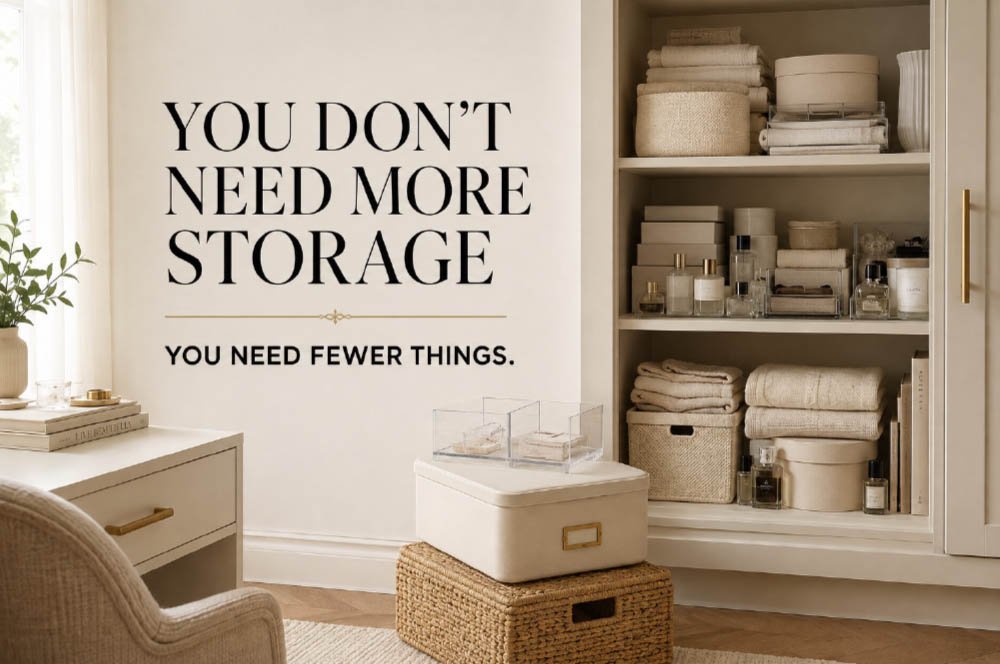
If you’ve ever bought a basket, bin, drawer organizer, or cute storage container and thought, “This is finally going to get me organized,” you are not alone.
You bring it home. You arrange everything beautifully. For a little while, it looks amazing.
Then a few weeks later, the drawer is overflowing again, the countertop is covered, and the house still feels overwhelming.
What happened?
The problem probably wasn’t the container.
Most people don’t actually have an organization problem. They have a clutter problem.
And there is a huge difference.
Cleaning, Organizing, and Decluttering Are Not the Same
One reason so many women feel frustrated in their homes is that we use the words cleaning, organizing, and decluttering interchangeably.
But these are three completely different jobs.
Cleaning maintains your home
Cleaning includes wiping, vacuuming, scrubbing, doing laundry, washing dishes, and removing dirt.
It keeps your home sanitary and cared for.
Organizing arranges what you own
Organizing means deciding where your belongings will live and arranging them in a way that makes sense.
This is where bins, labels, dividers, baskets, and systems can be useful.
Decluttering reduces what you own
Decluttering means removing the things you no longer love, want, use, or need.
It lowers the volume of belongings you have to manage.
That difference matters because most people are trying to organize clutter instead of remove it.
Organizing can make your possessions look neater, but it doesn’t automatically reduce how much you own. Sometimes it simply rearranges the excess—or hides it inside prettier containers.
You can organize your home beautifully and still feel completely overwhelmed living in it.
When “I Need to Get Organized” Really Means “I Have Too Much”
I hear this from clients all the time:
“Margo, I need help getting organized.”
But when I walk into the home, the main issue usually isn’t a lack of organization.
It’s excess.
There is too much stuff to manage.
Too much visual noise.
Too many things competing for attention.
Too many decisions waiting to be made.
The kitchen cabinet doesn’t necessarily need a better system. It may simply contain twice as many mugs as the household uses.
The closet may not need another shelving unit. It may need fewer clothes that don’t fit, don’t feel good, or haven’t been worn in years.
The bathroom may not need an elaborate collection of acrylic organizers. It may need fewer expired products, disappointing hair treatments, and makeup nobody uses.
Before you decide that a space needs a new organizing product, ask yourself:
Does this area need a better system—or does it need less stuff?
Bins Are Not Magic
Listen, I love a good bin as much as the next person.
A well-chosen container can make a drawer easier to use. A basket can give frequently used items a clear home. A lazy Susan can make the back of a cabinet accessible.
But these products are only helpful after you’ve decided what deserves to stay.
Bins are not magic.
If your kitchen drawers are overflowing, buying prettier containers for the overflowing stuff doesn’t solve the actual problem.
It gives the clutter a nicer apartment.
And this is where the organizing industry gets us a little.
We are constantly being sold the idea that the next product will be the solution:
The matching basket set.
The acrylic container.
The drawer divider.
The color-coded labels.
The storage system you saw while casually walking through Target and somehow left the store owning.
These products can absolutely help—but they cannot solve clutter.
Because clutter isn’t primarily a storage problem.
It’s a volume problem.
More Storage Can Lead to More Stuff
Sometimes adding storage is necessary. If your home has no coat closet or your kitchen genuinely lacks functional cabinetry, a thoughtful storage solution can improve your life.
But more storage can also make it easier to avoid decisions.
An empty basket invites us to fill it.
A new shelving unit gives us permission to keep more.
A storage bin moves unwanted items out of sight without requiring us to decide what to do with them.
Then, six months later, we no longer remember what is inside the container. We only know we have to move it whenever we need something behind it.
If you don’t know what is stored in a bin, don’t use what is stored in the bin, and wouldn’t look for those things if the bin disappeared, the container isn’t organizing your life.
It’s storing postponed decisions.
Why Too Much Stuff Feels So Heavy
Clutter can feel exhausting even when your home isn’t technically dirty.
Every pile, overstuffed drawer, and random item sitting on the counter gives your attention one more thing to process.
Some of those objects represent unfinished tasks:
The mail you need to open.
The item you need to return.
The clothes you need to donate.
The appliance you meant to repair.
The stack you promised yourself you would sort.
Even if you aren’t actively thinking about each item, the room can still feel busy. It can be difficult to relax when every surface reminds you of something you haven’t handled.
That is why one home may feel calming while another makes you tense the moment you walk into it.
The more things you own, the more things you have to clean, move, arrange, maintain, remember, and make decisions about.
Your home begins to feel heavy because managing it has become heavy.
Decluttering Makes Everything Else Easier
When you reduce the volume of belongings in your home, everyday tasks require less effort.
Cleaning becomes easier because you don’t have to move 15 things before wiping a surface.
Organizing becomes easier because the items you keep have room to fit comfortably.
Getting dressed becomes easier because your closet contains clothes that work for your body and your life.
Putting groceries away becomes easier because your cabinets aren’t filled with expired ingredients and foods nobody eats.
Maintaining your home becomes easier because there is simply less to manage.
Your home begins working with you instead of against you.
That is why decluttering needs to happen before organizing.
First, decide what stays.
Then create a system for it.
And only after that should you decide whether you need a container.
Please Don’t Empty the Entire Room
At this point, you may be thinking, “Great. Now I have to declutter my whole house.”
No.
Please don’t pull everything out of every closet and create complete chaos.
The goal isn’t to destroy your home in the name of decluttering. The goal is to reduce what you own consistently enough that your home becomes easier to maintain over time.
This is why I believe in micro-decluttering and the Spot & Toss™ method.
You don’t need an empty weekend.
You need small, repeated decisions.
One drawer.
One shelf.
One category.
One item you already know can go.
That is how you create momentum without overwhelming yourself. It is also how you build a habit that can continue after the big decluttering session is over.
Ask “What Can Leave?”
This week, choose one small area:
A bathroom drawer
One kitchen cabinet
A single shelf
Your car console
The basket where random things collect
One section of your closet
Before you organize it, ask:
“What can leave?”
Not:
“Where can I store this?”
Not:
What kind of container should I buy?”
Not:
“Could I possibly use this one day?”
What can leave?
Remove what is expired, broken, unused, uncomfortable, or no longer wanted. Then look at what remains.
You may discover that you don’t need another bin at all.
Remember: you do not need a perfectly organized home.
You need a home that is manageable.
And that begins by reducing the things that are making your life harder in the first place.
With Love,
Margo
Ready to Build the Habit?
Join the 7-Day Spot & Toss™ Decluttering Challenge for one small area each day, quick audio coaching from Margo, and realistic action steps that fit into your life.
No all-day projects. No pulling your entire house apart. Just small decisions that create real momentum.