The 3 Rules of Organization That Actually Work in Real Life
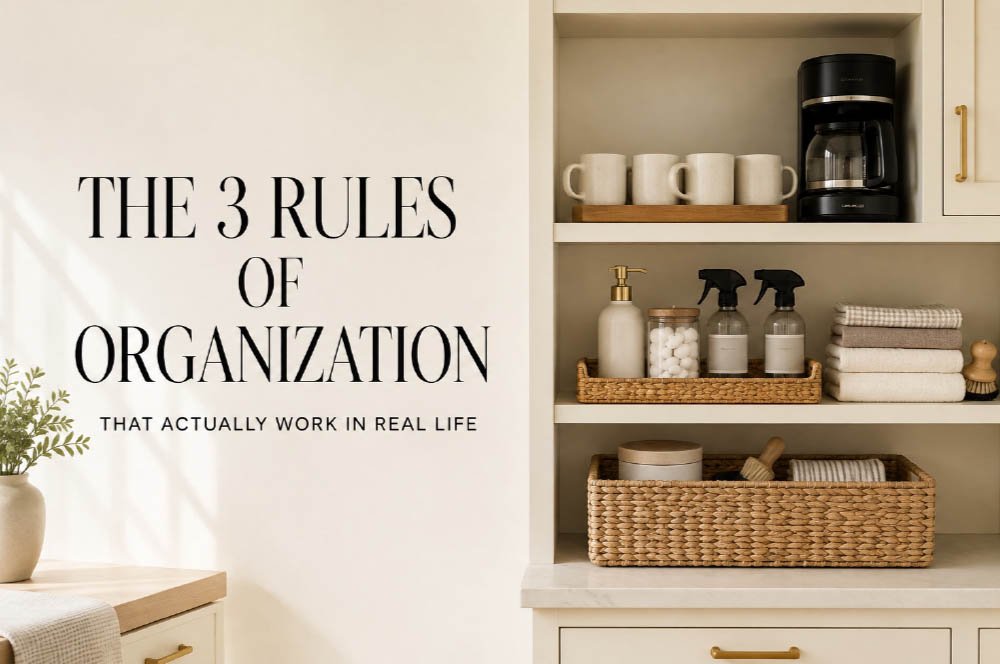
Let’s talk about organization—real organization.
Not the Instagram pantry.
Not the perfectly labeled acrylic containers that look cute for six days until real life shows up.
I’m talking about organization that works in an actual home, especially when you’re a woman over 40 with a lot going on.
Kids. Work. Relationships. Aging parents. A calendar that basically attacks you.
I get it.
You don’t need a home that photographs perfectly. You need one that makes your everyday life easier.
But before we get to the three rules, I need to say something that may annoy you. And I’m saying it with love:
You Only Organize After You Declutter
Not before.
If you organize before you declutter, you’re spending time and money creating systems for things you may not even need.
Then, when the new system doesn’t work, you blame yourself.
You think:
“Why can’t I stay organized?”
“Why does this drawer keep getting messy?”
“Why doesn’t my house look like the picture?”
You didn’t fail. You simply tried to organize too much stuff.
So, if you’re thinking, “Margo, I just need better storage…”
No, lovely. You probably need a purge.
Declutter first. Decide what deserves to stay. Then organize what remains.
And before you purchase anything:
Measure Before You Buy Containers
I don’t care how cute the bins are.
Measure first.
Measure the height, width, and depth of the shelf, drawer, or cabinet. Pay attention to hinges, pipes, and anything else that may reduce the usable space.
Nothing is more annoying than ordering the “perfect” bins and discovering they don’t fit your cabinet.
Now you don’t have an organizing solution.
You have new clutter—and a return to make.
Once you’ve decluttered and measured, use these three rules to create organization that works in real life.
Rule 1: Functionality
Store things where you use them.
This rule changes everything because it isn’t about making your home perfect. It’s about making your home easier to live in.
Good organization should help you move through your day with less effort.
Less searching.
Less rebuying.
Less yelling, “WHO TOOK MY—” whatever.
Ask yourself:
Where do I naturally reach for this item?
That is probably where it should live.
Put coffee mugs near the coffee machine
Your mugs don’t need to live across the kitchen like you’re training for a marathon at 6:30 in the morning.
Store the coffee, filters, mugs, and anything else you use for your morning routine in the same general area.
Keep cooking essentials near the stove
Cooking oils, frequently used spices, and utensils should be close to where you cook—not in a random cabinet simply because that’s where they fit when you moved in.
Just keep anything flammable a safe distance from heat.
Store makeup where you actually get ready
If you do your makeup at a bedroom vanity, that is where your everyday makeup should live.
If you always end up putting it on in the car mirror—no judgment—stop creating an elaborate system in an upstairs bathroom you don’t use in the morning.
Organize around your real routine.
Give backpacks a home near the door
If your children drop their backpacks near the entryway every afternoon, create a landing spot there.
Don’t design a system that depends on everyone carrying their bags upstairs and remembering to bring them down again each morning.
We all know how that story ends.
Functionality means accepting the way your household naturally moves and creating systems that support it.
Stop organizing for Fantasy You. Organize for Real You.
Fantasy You may decant every snack into a matching container, fold every shirt perfectly, and return every item to a distant storage closet.
Real You has eight minutes before leaving the house and is trying to remember whether anybody fed the dog.
Your organization needs to work for her.
Rule 2: Like With Like
Group similar items together.
This rule is simple, but it solves one of the main reasons people feel disorganized even when their homes are clean.
When similar items are scattered throughout the house, your brain is constantly trying to remember where everything is.
You also end up buying duplicates because you can’t see what you already own.
Whenever it makes sense, group categories together:
Batteries with batteries
Tape with tape
Hair products with hair products
Gift wrap with gift wrap
Light bulbs with light bulbs
Pants with pants
Shirts with shirts
Cleaning products by use or location
Right now, many of you have scissors in the kitchen, scissors in the desk, scissors in the junk drawer, and scissors in a random basket.
And somehow, when you need scissors, you still can’t find scissors.
When you group like with like, you can see what you own, find what you need, and recognize when a category has become excessive.
You may discover that you don’t need to buy batteries—you have 24 of them in three different rooms.
Or that you don’t need another roll of tape. You already own seven, but none of them were living in the same place.
This rule doesn’t mean every single item in a category has to live together if that wouldn’t be functional.
For example, you may keep one pair of scissors in the kitchen and another at your desk because you regularly use them in both places. You might store daily cleaning supplies near the rooms where you use them, while keeping refills together in a separate area.
That is fine.
The goal is not perfection.
The goal is this:
When you need something, you know where to look first.
That is organization.
Rule 3: Contain
Give each category a home—and a boundary.
“Contain” does not automatically mean “buy containers.”
It means your belongings need a defined amount of space.
Without a boundary, clutter spreads like it pays rent.
A container can be:
A bin
A drawer
A shelf
A basket
A shoebox
A tray
One small section of a cabinet
Anything that creates a clear limit can serve as a container.
That boundary says:
“This is the home for this category, and this is how much space it gets.”
And here is the important part:
If It Doesn’t Fit, You Probably Have Too Much
The first answer isn’t always, “I need a bigger container.”
Sometimes the answer is that the category needs to be edited.
Containment gives you a built-in signal. When the container is full, it’s time to look at what you own before adding more.
That could mean:
A small bin for charger cords
A basket for dog supplies near the door
One drawer section for everyday makeup
A shelf bin for snacks
A tray or file box for incoming mail—not the entire counter
One shelf for extra towels
A basket for children’s art supplies
The physical boundary helps stop the category from spreading into the rest of the room.
Your mail has a home, so it doesn’t cover the dining table.
The dog leash has a home, so you aren’t searching for it while your dog is staring at you like this walk is never going to happen.
Chargers have a home, so random cords don’t take over every drawer in the house.
Containment is how you prevent categories from turning into piles.
The Three Rules at a Glance
Here are the three rules of real-life organization:
Functionality: Store items where you use them.
Like with like: Group similar things together.
Contain: Give every category a home and a boundary.
And remember the two steps that come first:
Declutter before you organize.
Measure before you buy.
You do not need an Instagram-perfect pantry or a label on every object in your home.
You need simple systems that make sense to you and the people who live with you.
Try This 10-Minute Organization Reset
We’re not going to read this, nod thoughtfully, and then do absolutely nothing.
Choose one small area:
Your coffee station
Your everyday makeup
The snack cabinet
Your entryway
One bathroom drawer
Set a timer for 10 minutes and follow these four steps:
Remove what doesn’t belong. Toss, recycle, donate, or relocate anything that shouldn’t be in that space.
Group similar items. Put like with like so you can see what you own.
Store items where you use them. Make the space work with your actual routine.
Create a boundary. Give the category a drawer, shelf, basket, tray, or clearly defined section.
Then stop.
That is enough.
You don’t need to redo the entire room. You don’t need to order a 36-piece organizing system.
And you definitely don’t need to make a Target run.
Real organization isn’t about making your home look perfect.
It’s about making your home easier to live in.
With Love,
Margo